Showing posts with label Instrumentarium. Show all posts

Tuesday, February 5, 2008

Harry Partch - The Kithara

As you might have noticed by now, many of Partch's instruments went through several versions, creating a bit of confusion regarding their numbering. We've seen the different Adapted Guitars and Chromelodeons; today's instrument has a less twisted history, but still comes in many flavors.

The Kithara is, along with the Chromelodeon, one of Partch’s oldest instrumental conceptions. In 1934, he traveled to England under the Carnegie Corporation in order to study tuning at the British Library and attempt to develop a justly-tuned instrument. That fall he met Kathleen Schlesinger, a musicologist and ancient Greek scholar who had built several replicas of Greek instruments and written about her findings in the Encyclopedia Britannica. Partch was ecstatic to make her acquaintance and eager to see the Kithara she had constructed out of wood from an orange box using the pictures on Greek vases as her guide. They met for tea, shared sketches of instruments, and Partch left wanting to construct his own Kithara.

He was attracted to the instrument because of its Greek origins and the knowledge of Greek tuning he gained that fall in the British Library. In 1938, he built his first Kithara, an alto version of the instrument, and began using it in his Americana compositions almost immediately. It was a large instrument, almost six feet tall, and served him well until 1952, when he restrung and retuned it. In the process of adapting the Kithara I, he realized he wanted more bass resonance, and so, in 1954 in Sausalito, California, he built the seven-foot tall Kithara II as a bass instrument.

Both Kithara I and Kithara II use seventy-two guitar strings arranged vertically in twelve groups of six strings each. Eight of these hexads are tuned to fixed pitches, while the remaining four use moveable pyrex rods to change the pitches during performance, resulting in a sound similar to that of a slide guitar.

By 1972, he decided to replicate the Kithara I in order to make a stronger, more playable instrument that had increased resonance. As he often remarked, he didn't have 200 years of manufacturing know-how behind him as piano makers do, so he needed a little trial and error to sort things out.

This excerpt is from Partch's And on the Seventh Day Petals Fell in Petaluma and features the Kithara II accompanied by the Marimba Eroica. You'll notice the Kithara II because of the alternation of delicate plucked strings that swoop and swerve thanks to the pyrex rods along with sweeping chords along the hexads:


Saturday, September 29, 2007

Harry Partch - The Diamond Marimba

Today's instrument is one of Partch's first forays into the world of percussion. When he was presenting his music around New York City in 1943 and 1944, one of the most frequent criticisms he received was that his music lacked rhythmic interest. Many seemed to feel that Partch concentrated too hard on pitch to the exclusion of rhythm.

So when he arrived in Madison, Wisconsin, Partch set to work adding some "rhythmic interest" by creating percussion instruments. One of the first fruits of this new focus was the diamond marimba.

Before describing that instrument, I need to make a slight detour. One of Partch's great contributions to microtonal theory was his formulation of the tonality diamond. In the diamond, he took his starting pitch (a G for him) and built chords of six pitches above it following the overtone series to the 11th limit (which he called otonalities) and then built chords of six pitches flipping the overtone series and going down (which he called utonalities). He then arranged these in a diamond shape with the starting pitch (that G) in the middle and the otonalities moving up towards the right and the utonalities moving down towards the right, resulting in 29 pitches altogether. It looks like this:
(Here's a website where you can listen to the various pitches.)

Right up the middle, you can see the same pitch rendered in the various limits - 1/1, 3/3, 5/5, etc. Recognize this shape? Yes, the diamond marimba is nothing more than the tonality diamond come to life with a few modifications for ease of playing. Partch worked with Warren E. Gilson in Madison to create the instrument, making the blocks out of Brazilian rosewood and Pernambuco, mounting them on thin foam rubber, placing resonators of Brazilian bamboo below the blocks, and holding the entire thing together on a stand of white pine with bronze posts supporting it.

Here's the beginning of Partch's song "The Waterfall." You'll hear the diamond marimba make runs as well as the sweeping chords that are its most distinguishing characteristic:


Saturday, August 18, 2007

Harry Partch - The Chromelodeon

The Chromelodeon is one of my favorite of Partch's instruments because it is an adaptation of a keyboard instrument, it has a wonderful name, and because it is just so darn colorful.

The Chromelodeon is actually one of Partch's earliest conceptions for an instrument; when he was studying in England in 1934, he drew up plans to build a justly-tuned keyboard instrument he called the Ptolemy. It was a reed organ with a typewriter keyboard and he had a mock-up built, but the instrument broke during shipping back to the states and he abandoned it in favor of the Chromelodeon.

There are actually three Chromelodeons:

Chromelodeon I - a six-octave melodeon (hence the final part of the name) that he obtained in Chicago for experimental purposes. He turned it to play all the chromatic "colors" of his scale (hence the first part of the name) and it has six stops and a series of sub-bass keys to augment the sound it is capable of producing. The keyboard is color coded with bright primary colors to represent the various harmonic relationships between pitches. This was the instrument he used in his early Americana works.

Old Chromelodeon II - originally a chapel organ with a five octave range and four planes of keys on the keyboard. This doubling of keys made it easy to play Partch's music, but he lacked the skills to service the organ and abandoned it in 1949.

Chromelodeon II - a full piano keyboard of 88 keys drew Partch to this version in 1950. It is another reed organ, but Partch tuned it to all the unusual tunings he used in Oedipus, Revelation in Courthouse Park, and Delusion of the Fury so he didn't have to constantly retune the Chromelodeon I.

The sound of all three is as you would expect - imagine being in an old country church singing hymns to a pump organ and you have the sound in your head. But what was amazing to me about Partch's use of the instrument was his ability to make it sound so fresh and new and unlike you might expect. Here's a clip from U.S. Highball, where he often makes the Chromelodeon sound like a train:


Friday, July 27, 2007

Harry Partch - The Adapted Guitars

Today's instruments are a bit confusing because Partch shifted the roman numerals he used to name them during his life.

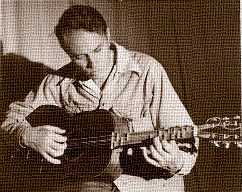
Partch bought and altered his first Adapted Guitar (pictured here thanks to Corporeal.com) in 1934 and used it to compose and perform his Americana works Barstow and U.S. Highball. He fitted the guitar with high, stainless-steel frets on a brass plate that was screwed into the neck to aid in tuning the guitar to just intonation.

In 1945, he adapted a guitar with a smooth and narrow fingerboard by adding pinheads and brass rivets and filing them down to be equal to the the fingerboard's level.

That same year, Partch adapted a Hawaiian guitar, complete with a plastic rod to make gliding pitches possible. While the six strings of the first two guitars were tuned in three pairs of octaves (2/1), each a third (5/4) apart, the ten strings of the third guitar are tuned according to one of Partch's hexads.

Obviously he couldn't call all three instruments "Adapted Guitar," so he started calling the second guitar Adapted Guitar I, the Hawaiian guitar Adapted Guitar II, and the original guitar Adapted Guitar III. But in 1956, he gave up on the second guitar and renamed the original guitar Adapted Guitar I.

Confused? I thought so. All you need to remember is that Partch ended up with two guitars - Adapted Guitar I, which was the original and has six strings, and Adapted Guitar II, which is based on a Hawaiian guitar and has ten strings.

Here's an excerpt from Partch's Barstow performed on Adapted Guitar I:


Friday, July 6, 2007

Harry Partch - The Adapted Viola

This year I'll be teaching my class on Music since 1945 again, and I've already started collecting wonderful resources to use, like this website that has recordings of the bird calls Messiaen used to compose Réveil des oiseaux along with cute little pictures of the birds and this one that automatically generates your twelve-tone matrix from a tone row. There is an incredible website where you can play Harry Partch's instruments, and Corporeal Meadows has good information on many of his instruments, but I haven't found a resource that suits my purposes and lists all his instruments with pictures and short commentary.

So I'm making it myself.

Over the next few months I'll slowly profile Partch's Instrumentarium so that hopefully, come next spring, I'll have a complete list ready for use. And hopefully, since many of you have wondered about Partch's music, you'll enjoy this little taste of the scholarly work I do as well.

Adapted Viola
(photo by Fred Lyon)

A combination of the viola and cello, the Adapted Viola was Partch’s first attempt at adapting an instrument to just intonation. He created the fingerboard in 1928, but it wasn't until two years later while in New Orleans that he hit upon the idea of putting it on a viola's body.

The instrument consists of an average-size viola soundbox with a neck and fingerboard that is six inches longer than usual. The tuning pegs are from a cello, as are all the strings except the first, which is a double-length violin first string. Instead of frets, the fingerboard is marked with a series of brads hammered in beside the strings to mark the various pitches, 37 to the octave at this point in Partch's career. As you can see, the Adapted Viola is played with a bow and the instrument is held between the legs. The Adapted Viola’s range is expanded from the traditional viola to rest between the cello’s and the violin’s.

Partch's first large-scale work in just intonation, The Seventeen Lyrics of Li Po, was written for this instrument and solo voice and is hauntingly beautiful. Here's a bit of the beginning of "A Midnight Farewell:"


The Adapted Viola started Partch on his instrument building path, and it remained central to his music through the 1940s.